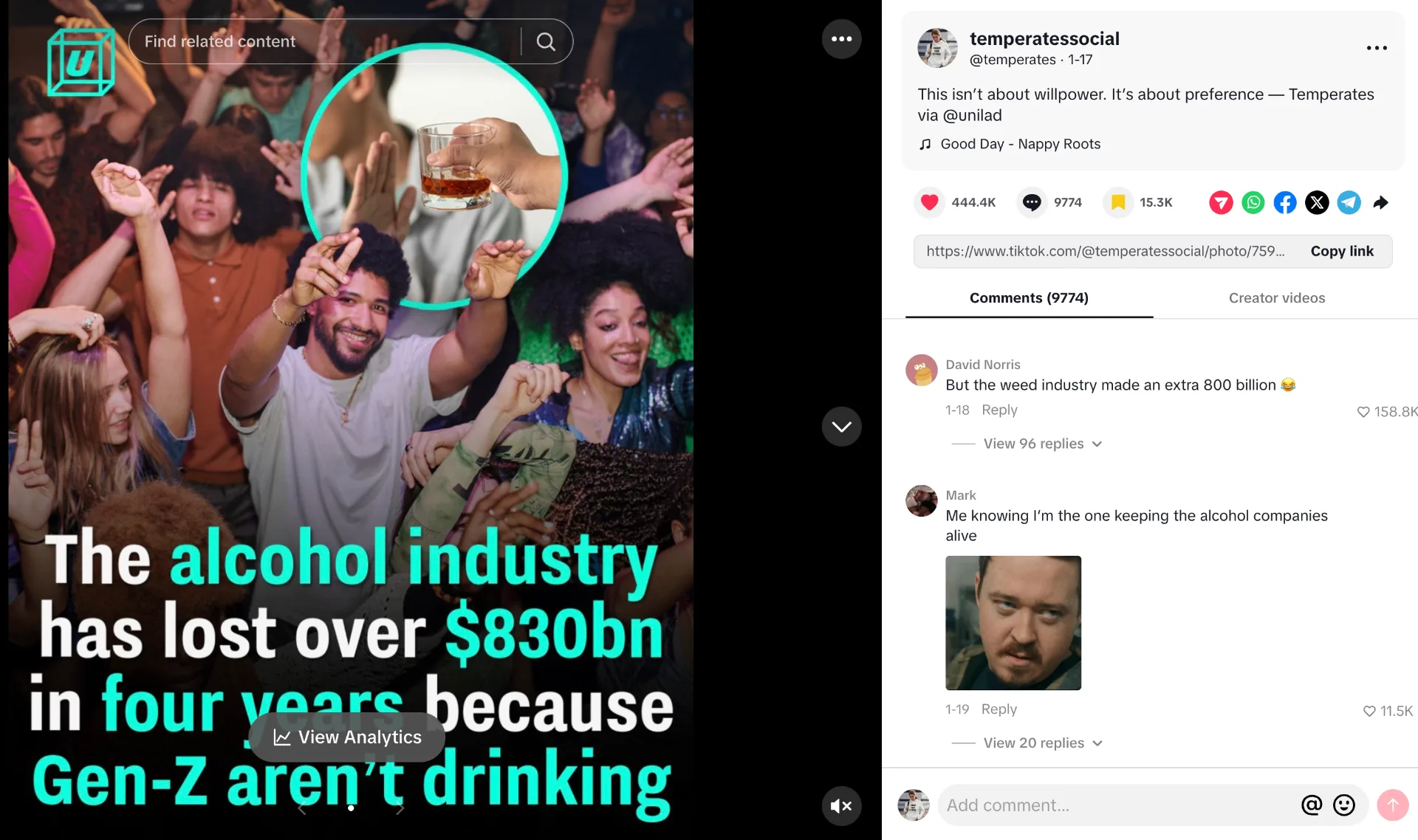

Gen Z is drinking less, but mostly not for the wellness reasons in the headlines. I analyzed 7,032 comments on a viral Temperates TikTok post. Among those that gave a clear reason, about 42 percent pointed to cannabis and 33 percent to cost. Health came in around 8 percent. Less alcohol doesn't necessarily mean less intoxication.
Let's start with the statistic that keeps circulating. The global alcohol industry has reportedly lost more than $830 billion in market value over the past four years, and one explanation is repeated constantly: Gen Z simply isn't drinking like previous generations.
You've probably heard the reasons. Gen Z cares more about mental health. They prioritize sleep. They're more wellness-focused. Maybe.
But before repeating the narrative, I wanted to look at something far less filtered: what people actually say when they talk about drinking.
That matters, because most of the conversation around Gen Z drinking has been driven by headlines, surveys, and industry interpretation, not by large-scale analysis of how people describe their own behavior in the wild.
Recently, a post on the Temperates TikTok account went viral, generating nearly 5 million views and close to 10,000 comments debating whether Gen Z is really drinking less and why.
Instead of guessing, I analyzed the full comment dataset from that discussion.
Because TikTok skews young, and because the platform recommends content based on user behavior and interests, it is reasonable to infer that the discussion reached primarily Gen Z and younger millennial users.
What emerged wasn't the tidy wellness story making the rounds. It was something much messier. And much more honest.
Is Gen Z drinking less, or swapping alcohol for cannabis?
Much of the conversation around declining alcohol consumption tends to frame it as a health and wellness shift. But when thousands of people talk about the topic directly, another theme appears again and again.
From the 7,032 comments analyzed, roughly one third expressed a clear reason for drinking less. Among those responses, the breakdown looked roughly like this:
Based on thematic analysis of 7,032 TikTok comments. Percentages reflect share among comments expressing a clear reason for drinking less.
What stands out immediately is that wellness was not the dominant explanation. Cannabis substitution appeared far more often.
Hundreds of commenters referenced it directly.
Some were blunt: "We're not sober. We're just high now."
Others described the experience itself: "Alcohol hangovers are awful. Edibles are better."
This doesn't mean Gen Z is becoming a cannabis generation. But it does highlight something the current narrative often skips over.
Less alcohol doesn't necessarily mean less intoxication.
Sometimes it simply means alcohol is losing ground to something else.
How much does cost explain?
The second most common explanation was even simpler. Alcohol has gotten expensive. Not slightly expensive. Bar-tab expensive.
If alcohol is losing because it costs more and delivers a worse experience, that is not a PR problem. It is a category problem.
 Temperates
Comment after comment pointed to the same reality: "A cocktail costs $16." "One drink equals half an eighth." "I'd rather spend that money on food."
For a generation navigating rising rent, student debt, and inflation, traditional bar culture is harder to justify than it used to be.
Some behavior changes aren't philosophical. They're financial.
The Wellness Story
Health motivations did appear in the dataset. Some commenters mentioned anxiety, sleep, fitness goals, or simply disliking hangovers. But those responses represented a much smaller share of the discussion compared with substitution and cost.
That doesn't mean the wellness shift isn't real. It simply means it's one factor among several driving the change.
A More Honest Explanation
When you look at thousands of unfiltered comments, the story isn't a single clean narrative. It's several forces happening at once. Substitution. Cost pressure. Changing social habits. And yes, some genuine health awareness.
Gen Z does appear to be drinking less. But the reasons behind that shift are more complicated than the simplified narrative currently circulating.
Why does this matter?
It is not enough to observe that Gen Z is drinking less. The more important question is why.
Because if the real drivers are cost and cannabis, then the alcohol industry may be misreading the shift entirely. This is not just a wellness story. It is a competitiveness story.
If alcohol is losing because it costs more and delivers a worse experience, that is not a PR problem. It is a category problem. That should worry the industry more than any headline about moderation.
Consumers are not necessarily rejecting intoxication altogether. They may simply be choosing forms that feel cheaper, easier, or less punishing. The threat, then, may not simply be abstinence. It may be replacement.
The real story may not be that Gen Z suddenly became the healthiest generation in history. It may be that younger consumers are rethinking whether alcohol still earns the role it once assumed in social life. And if nearly 10,000 people show up to debate that question under a single TikTok post, it's a sign the conversation is far from settled.
Methodology
This analysis examined 7,032 public TikTok comments responding to a viral Temperates post about Gen Z drinking habits. Comments were exported using Bright Data and coded into thematic categories based on the primary reason expressed for drinking less.
Because commenters self-selected into the discussion and TikTok's algorithm skews younger, the dataset should be interpreted as large-scale qualitative sentiment analysis, not a representative population survey.
Temperates Takeaway
Gen Z may be drinking less. But the shift isn't just about wellness. It's about substitution, economics, and a broader reconsideration of alcohol's place in social life. And that conversation is only getting started.