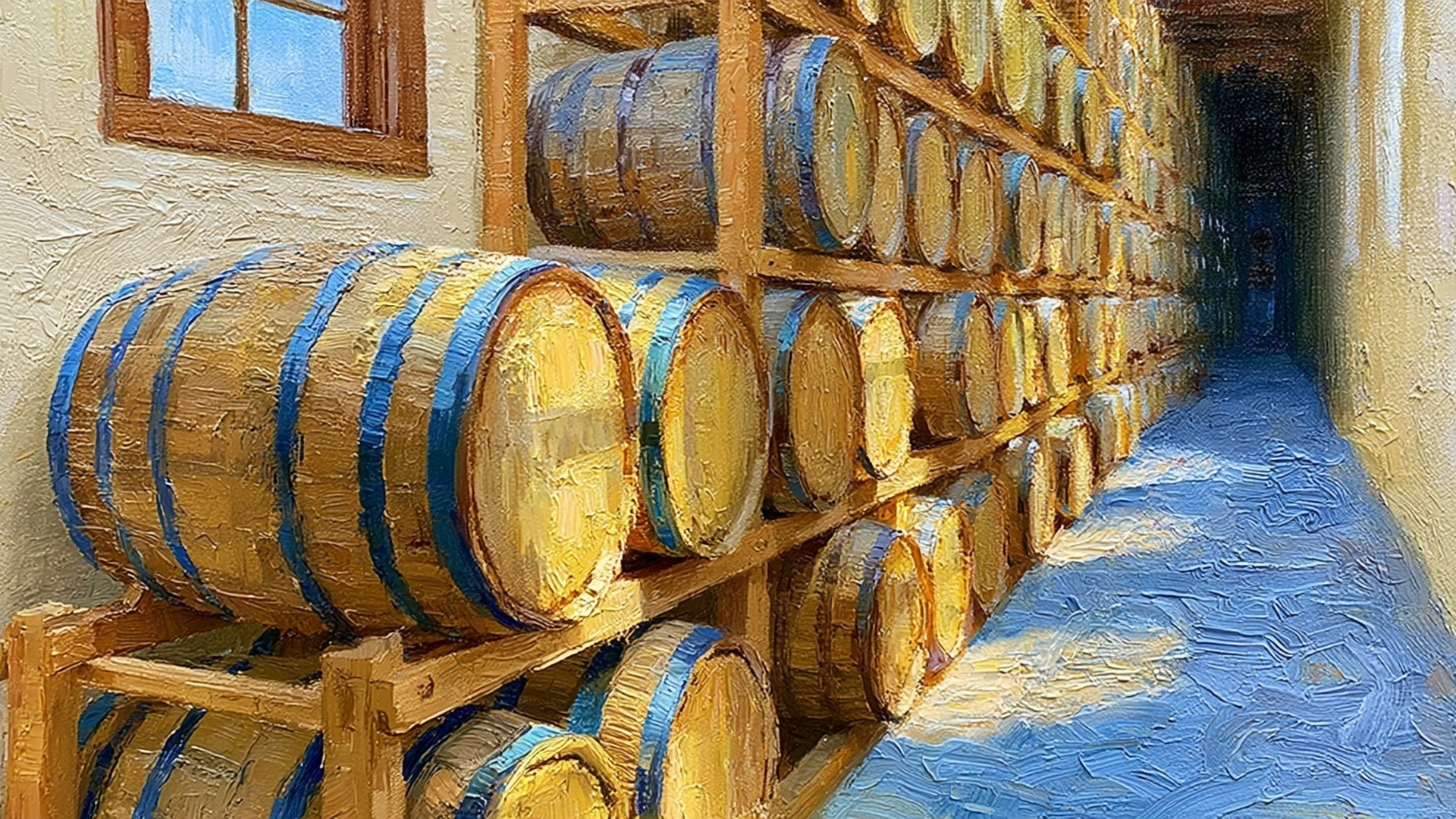

The world's distillers filled billions of dollars of barrels for a decade of drinking that is not happening. Their warehouses are now the most honest record of how much has changed.
Somewhere in Scotland there is a barrel that was filled in 2021 and was not supposed to be opened until the 2030s.
That barrel is a prediction. Someone looked at pandemic drinking numbers, at fifteen years of people trading up to better bottles, at a category that had grown almost without interruption, and decided the world would want that whiskey in ten years. Then they filled it, rolled it into a warehouse, and recorded it on the balance sheet as an asset.
The prediction is still sitting there. It is aging, it is expensive to hold, and it is getting harder to sell.
The size of the miss
Last winter the Financial Times added up the maturing stock held by five of the biggest listed alcohol companies: Diageo, Pernod Ricard, Campari, Brown-Forman and Rémy Cointreau. Together they were sitting on roughly $22 billion of aging spirits, the highest inventory level in more than a decade.
Rémy Cointreau is the sharpest version of the problem. The cognac house was holding about €1.8 billion of maturing stock, roughly $2.1 billion, close to double its annual revenue and not far from the entire value of the company on the stock market. Its sales tell you why. In the fiscal year that ended in March 2023, Rémy reported roughly €1.55 billion in sales, about $1.8 billion. For the year ending March 2026, it reported €935 million, about $1.1 billion. That is about 40 percent of the business, gone in three years.
Diageo, the largest spirits company in the world, announced roughly $1 billion in cost cuts over three years this August after full-year organic sales fell 2 percent, with US spirits down 11.5 percent. Across the industry, distilleries have been paused, cooperages sold, staff cut. The resale price of a used bourbon barrel has fallen from more than $200 at the end of 2024 to around $50. Some are being sold as garden planters.
Time is the whole business model
Aged spirits are the only consumer category where the product has to be manufactured a decade before anyone decides whether they want it.
Every barrel is a forecast, and the forecasting window is longer than most careers.
 Temperates
A twelve year old scotch is priced on the twelve years. That is the moat. No competitor can conjure one overnight, and no company can respond to a bad quarter by making more of it. Which means every barrel is a forecast, and the forecasting window is longer than most careers.
The forecasts made between 2021 and 2024 assumed the drinking would continue. It did not.
What actually happened
In August 2026, Gallup found that 54 percent of American adults say they drink alcohol. That is the lowest figure in a trend running back to 1939, and it is the second consecutive year at that number, down from 62 percent in 2023. A record low 13 percent say they sometimes drink more than they think they should.
Roughly half of Americans now believe that one or two drinks a day is bad for your health. In 2001 that number was 27 percent.
The people still drinking are drinking differently. IWSR data shows that across major markets, 48 percent of alcohol drinkers are actively choosing to drink less, rising to 68 percent among people who buy no-alcohol and low-alcohol products. Almost everyone buying a zero-proof beer is also still buying regular beer. The behavior has picked up a name, zebra striping, which describes alternating alcoholic and nonalcoholic drinks across a night out. It is a new word for an old harm-reduction habit, and it roughly halves what you consume without requiring you to announce anything to anyone. The reasons behind it are messier than the wellness story usually allows, which I went through in The 8 Reasons People Are Drinking Less.
Add trade politics on top. Canadian provinces pulled American liquor from government shelves in March 2025. By this month, imports of US alcohol into Canada had fallen about 81 percent year over year, to $137 million from $718 million. Ottawa has now asked the provinces to restock, and a poll last month found 69 percent of Canadians said they were unlikely to buy American alcohol even if it returned.
What a glut does next
Here is the part that lands in your hand rather than on a balance sheet.
When a company is holding ten years of stock against shrinking demand, it has three levers. It can slow production, which is already happening. It can cut prices, which analysts have been warning could turn into a price war. Or it can find new occasions for the liquid it already owns.
That third lever is the one aimed at you. It looks like ready-to-drink cans, flavored spirits, lower-ABV formats, and drinks built for daytime, festivals, and picnics rather than the bar at ten at night. The industry did not invent those formats because it had a change of heart about moderation. It built them because moderation is where the remaining demand went, and there are billions of dollars of aging inventory that need somewhere to go.
Expect the marketing to get louder and the price to get softer. Both are signals of the same thing.
The clearest evidence that you are not the exception is an inventory line on a corporate balance sheet.
TemperatesThe part that is actually about you
If you have been cutting back, you have probably had the experience of feeling like the odd one out. The friend who orders the club soda. The person who leaves half a glass.
The clearest evidence that you are not the exception is not a wellness survey or a January trend piece. It is an inventory line on a corporate balance sheet. Some of the most sophisticated forecasting operations in the world spent four years betting real money on the assumption that you would keep drinking the way you did in 2021. They were wrong by about $22 billion.
None of this makes the next decision for you. Drinking less still happens one evening at a time, in a specific room, with specific people who may or may not notice. But you can stop treating it as swimming against the current.
The current changed. The warehouses are just the last ones to find out.
Temperates Takeaway
You do not need to read a balance sheet to know what it says.
Notice the next time a drink is offered to you cheaper, in a smaller can, in a new flavor, or at an hour that used to be too early for one. That is not the industry meeting you where you are. That is the industry moving inventory.
Drinking less is still a decision you make one evening at a time. Just make it knowing that the pressure you feel to keep up is coming from somewhere, and that somewhere has warehouses.
Sources and reporting notesShowHide
Gallup Consumption Habits survey, August 2026 and 2025; Financial Times reporting on maturing spirits inventories, January 2026; Rémy Cointreau 2023-24 and 2025-26 annual results; Diageo 2026 preliminary results and Capital Markets Day, August 6 2026; IWSR moderation and no-alcohol consumer data; The Conversation on damp drinking and zebra striping, July 2026; CBC News and The Globe and Mail on Canadian liquor bans, August 2026; Wall Street Journal reporting on used barrel resale prices. Euro figures converted at about $1.16 to the euro.