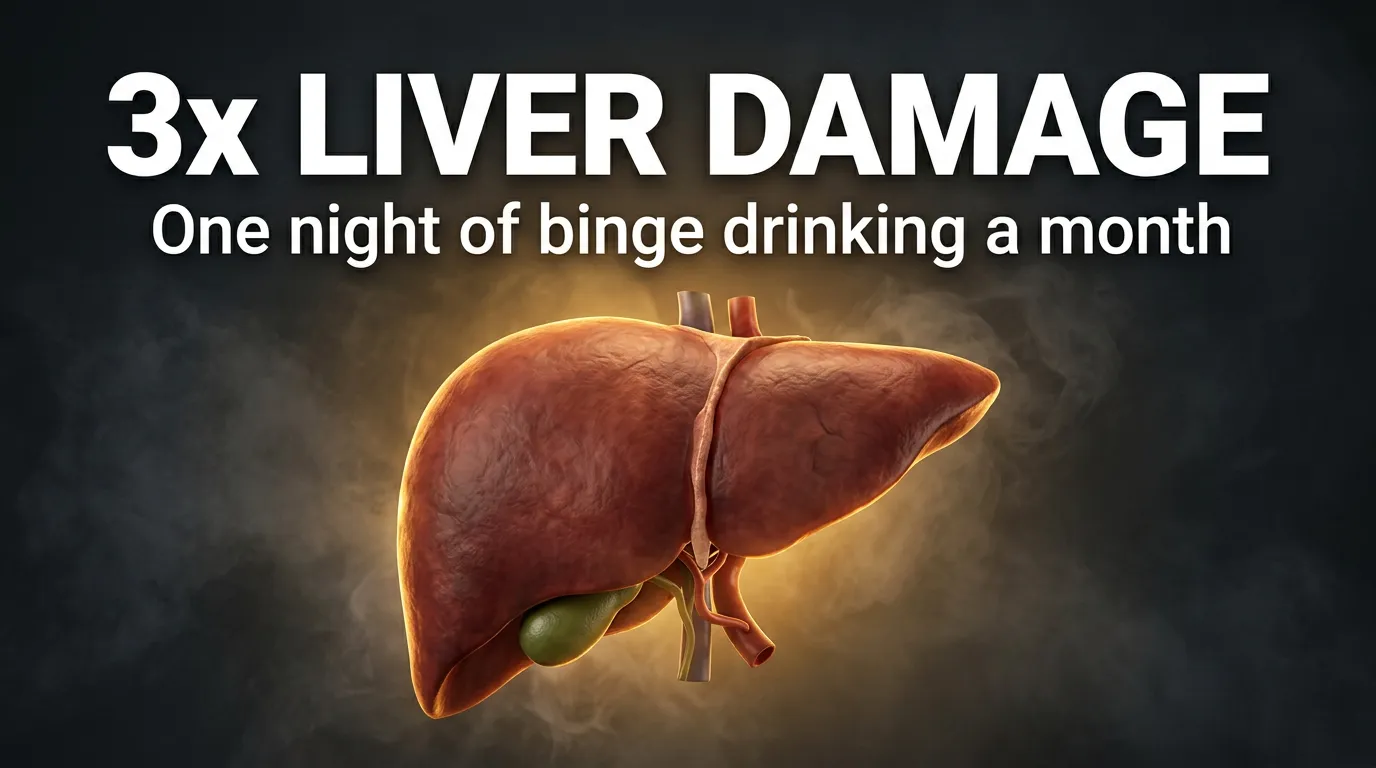

I sent my almost-18-year-old the headline: "One night of binge drinking a month can triple your risk of liver damage."
She didn't respond. But I already know how that conversation goes, because once I read the actual study, I realized she'd be right to push back. And that's the problem.
Where we keep getting stuck
Her position: "I'll just drink once in a while. But when I do, I'll go all in." Binge, but not often. Mine: drinking isn't healthy, and planning to binge, even occasionally, isn't a great strategy.
The headline looked like it proved my point. It didn't, at least not the way it was written.
What the study actually found
The research came from Keck Medicine of USC, published in April 2026. The team looked at survey and liver-scan data from more than 8,000 U.S. adults collected between 2017 and 2023. People who had four or more drinks in a day (women) or five or more (men) at least once a month were about three times as likely to have advanced liver scarring as people who spread the same total amount across the week. The effect showed up most clearly in people with fatty liver disease, known as MASLD.
It's a snapshot, not a study that followed people over time. It shows a strong link, not proof that one binge a month causes scarring in a healthy 18-year-old. That's the gap my daughter would spot in about four seconds.
The part the headline left out
Here's what didn't make the headline: MASLD affects about one in three American adults, and it's usually silent. Most people who have it don't know. So "this only applies to people with liver disease" isn't the escape hatch it sounds like. A lot of people are in that group without realizing it.
The honest version of the story is more useful than the scary one. How you drink matters, not only how much. The lead researcher said doctors have traditionally looked at total drinks, not how they're consumed. Saving it all up for Saturday is its own risk.
Why do lazy headlines backfire?
When a message doesn't fully apply to someone, they stop listening, not just to the headline but to you. Then you're not talking about behavior anymore. You're defending a claim. And when people don't trust the message, they go back to what feels true: that alcohol loosens things up and makes a night more fun.
It's the same trap I wrote about in The Date Says Today: the headline travels, and the study behind it gets lost.
Temperates Takeaway
I don't need a headline to scare her. I need one she can't poke holes in. Binge drinking isn't neutral, how you drink counts as much as how much, and a liver problem can be there long before anyone notices. If the headline is all you understand, you don't understand the risk. You just think you do.
I take apart one of these every Sunday. The signup is right below.
Sources and reporting notes (2)ShowHide
- Keck Medicine of USC. Occasional heavy drinking may triple the risk of liver damage. April 2, 2026.
- Su Y, Dodge JL, Lee BP. Episodic Heavy Drinking and Implications for Steatotic Liver Disease Nomenclature: A National Cross-Sectional Study. Clinical Gastroenterology and Hepatology, 2026. Summary via ScienceDaily.